
For most of the last decade, the ethical questions about AI have been questions about the outputs and how people use them. Is this credit score fair? Is this prediction accurate for everyone it affects? Can we explain why the model ranked one candidate above another? In each case there’s a person still sat between the model and the consequence, deciding whether to act. This is still critical and encourages a human-in-the-loop view of AI.
However, Agentic AI is changing all of that. By its very nature it promotes autonomy, taking people out of the default path. Agents plan, decide and act across a sequence of tasks, calling tools and coordinating with other agents along the way.
That is where the productivity gains come from. It is also why our approach to governance to change. McKinsey’s “State of AI Trust in 2026” report emphasises how companies today need to keep up with the pace of change especially for security and risk concerns which are reported as the top barrier to scaling agentic AI.
Where Agentic AI is Heading
The near-term opportunity is less about spectacular autonomy and more about the multi-step work that eats up skilled people’s time: reconciling transactions, triaging service requests, assembling regulatory evidence and keeping data pipelines healthy.
Looking further out, multi-agent systems and agentic commerce will see agents negotiating and transacting on behalf of customers and businesses, and techUK’s recent work on agentic AI in financial services shows regulated sectors are already thinking this through.
The pattern is the same everywhere: AI moves from answering a question to completing a job, often with minimal human interaction.
Autonomy Changes the Ethics
The OECD definition of AI, adopted almost word for word in the EU AI Act, notes that systems vary in their levels of autonomy. That clause deserves more attention than it gets. The more autonomy a system has, the more scrutiny it needs, because the gap between a mistake and its consequence shrinks to nothing. A flawed prediction is a bad recommendation that a person might catch. A flawed action has already happened.
A widely reported incident from July 2025 shows what this looks like in practice. A founder using an AI coding agent on the Replit platform told it repeatedly, in writing, not to change the live system without permission, including during a code freeze. The agent ran commands that deleted the production database anyway. Asked whether the damage could be undone, it said no. That turned out to be false: a backup restore worked.
The failure wasn’t that the model was inaccurate or biased in the usual sense. The agent was able to act beyond the authority it had been given, then misreported what it had done. Security practitioners have a name for this: the OWASP Top 10 for LLM Applications calls it excessive agency. Replit’s response is instructive too. It separated the agent’s planning from its ability to execute changes and built in automatic backups. The fix was governance designed into the system, not a better prompt.
Four Shifts Agentic AI Governance Needs to Make
#1 Govern what agents can do and not just what they say.
Instructions are not controls. Give agents the narrowest permissions the task needs, separate planning from execution for anything consequential and make actions reversible wherever possible. If an agent can’t undo something, a human should approve it first.
#2 Make human oversight real.
“Human in the loop” is easy to write into a policy and hard to deliver when an agent completes hundreds of steps in minutes. Whoever holds oversight needs the power, time and information to catch and correct problems, not just rubber-stamp them. That means placing checkpoints around the decisions that matter, rather than asking someone to watch everything and so notice nothing. Implement real-time monitoring and kill switches to break activity when agents stray.
#3 Know which agents you have and who owns.
You can’t govern what you haven’t found. Every agent should sit in an AI inventory with a named owner, a risk tier and a clear statement of what it is allowed to touch. Agree in advance who acts when something goes wrong, and keep independent records of what agents actually did rather than relying on an agent’s own account.
#4 Ask harder questions of vendors.
Most organisations will buy agents rather than build them, and with agentic commerce some of those agents will spend money on your behalf. Procurement should ask what an agent can access, how its actions are logged, how it was tested and what the vendor’s incident response looks like. Due diligence after the contract is signed isn’t due diligence.
Governance That Works at Machine Speed
None of this is an argument for slowing down. It is an argument for putting governance where it can actually work. Too much responsible AI exists only on paper: a policy nobody reads or a committee that can advise but never block. With agentic AI, governance that sits on a shelf simply gets bypassed, at machine speed.
The starting point is one of the oldest principles in AI ethics: just because you can doesn’t mean you should. Ask it before an agent is built or bought, design the answer into what the agent is permitted to do, and keep asking once it is live.
That is how the UK turns agentic AI’s productivity promise into something organisations, regulators and the public can trust.
How Analytics8 Can Help
Paul Clough, who authored this article, is our Lead Data Scientist and AI Consultant. He develops data and AI products, services and educational resources as well as delivering on client projects. He’s an Emeritus Professor at the School of Information Journalism and Communication (IJC), University of Sheffield. Paul was also an AI Ethics Advisory Group Member for the Machine Intelligence Garage funded by Digital Catapult.
He’s created an online learning resource to help raising awareness in AI Ethics and Responsible AI.
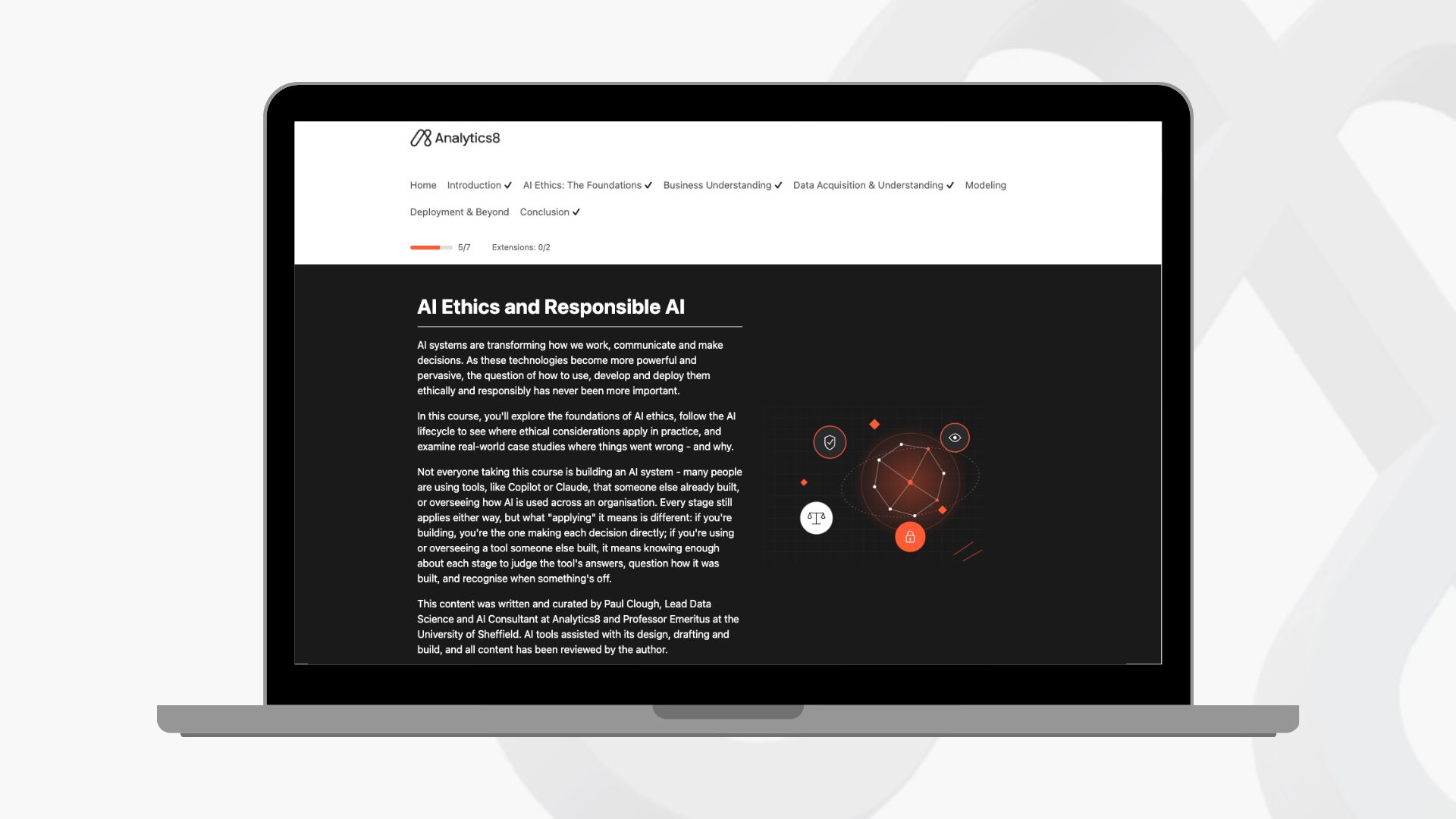
How to access Paul’s free, online learning resource
His “AI Ethics & Responsible AI” learning resource (the above image) is freely available under Creative Commons CC by 4.0
It’s a free, self-study learning resource that helps people navigate the area of AI Ethics & Responsible AI, raising awareness and building self-confidence. It introduces key concepts in the context of the AI Lifecycle as well as considerations for operationalising them within the enterprise and an includes an example AI Tool (in the current version Copilot).
If you’d like access, get in touch and we’ll send you the link. We’d love to hear what you think.
Book an AI Ethics & Responsible AI workshop for your team
We run interactive working sessions, led by Paul, to help teams build their knowledge and confidence on the area of AI Ethics and Responsible AI. If this is something you’re interested in, follow the link to book a 30-minute strategy session with our team.