
AI is no longer something that only data scientists work with. It drafts our emails, summarises our meetings, screens our data and, with agentic AI, increasingly takes action on our behalf. As it becomes part of everyday work, the question of how to use it responsibly stops being a specialist concern and becomes everyone’s. That is the thinking behind AI Ethics and Responsible AI, a free online course written and curated by Paul Clough, Lead Data Science and AI Consultant at Analytics8 and Professor Emeritus at the University of Sheffield.
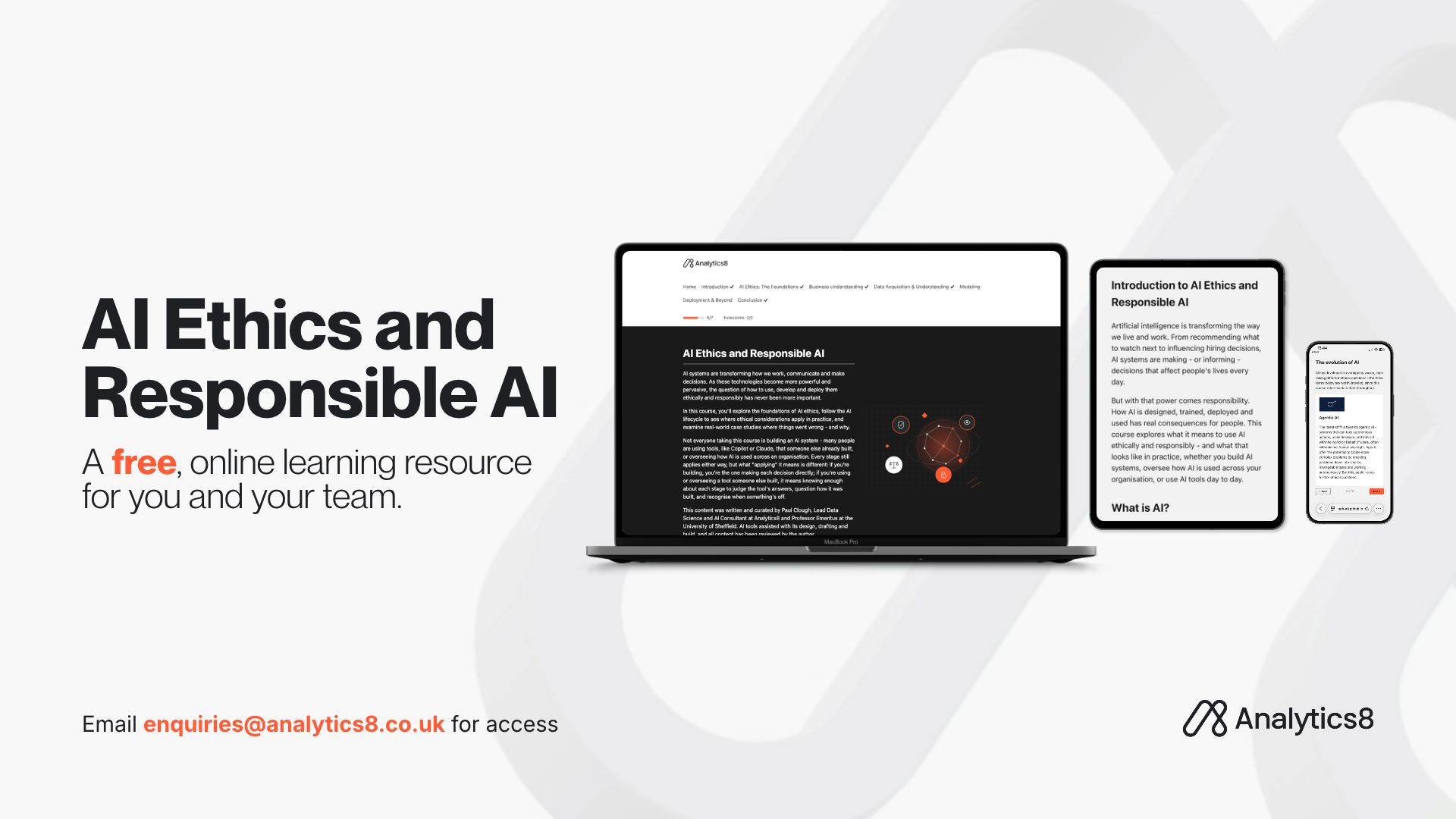
A Free, Online Learning Resource For Everyone Who Uses AI
Much of what is written about AI ethics sits at one of two extremes: academic discussion of principles or technical guidance for the engineers building models. Both matter. But many of the decisions that shape whether AI helps or harms are made elsewhere: by the team that chooses a tool, the manager who signs off a rollout and the person who decides whether to trust an answer.
This course is built for all of them. It recognises that not everyone is building an AI system. Many people are using tools like Copilot or Claude that someone else built, or overseeing how AI is used across an organisation. Every stage of the course still applies, but what it asks of you depends on where you sit.
Who it’s for
- People who build or configure AI systems, who make each decision directly, from the data they use to how a model is released.
- People who govern how AI is used, who decide which tools to adopt, set the rules for using them and ask vendors the right questions.
- People who use AI tools day to day, who decide what to trust a tool with and act as the human oversight in practice.
What it covers
The course follows the AI lifecycle in seven short stages, each taking around three to six minutes:
- Introduction. What AI is, how predictive, generative and agentic AI differ and why more autonomy calls for more scrutiny.
- The Foundations. AI as a socio-technical system and seven guiding principles, from fairness and transparency to accountability and societal and environmental wellbeing.
- Business Understanding. The most important question of all: is AI the right approach here? Plus how to run an AI Impact Assessment and how the EU AI Act classifies risk.
- Data Acquisition and Understanding. Five ways bias enters data before a model is trained, along with provenance, consent and the people who label data.
- Modelling. Explainability, fairness by design, testing across groups, model cards, security risks for large language models and the environmental cost of AI.
- Deployment and Beyond. Staged rollout, monitoring for drift, meaningful human oversight, planning for when things go wrong and responsible decommissioning.
- Conclusion. What responsible AI looks like for your role, six top tips and a printable Responsible AI Checklist.
The core course takes less than an hour. Two optional extensions then apply what you have learned: Using Copilot Responsibly looks at a tool many organisations have already rolled out, and Operationalising Responsible AI sets out a practical roadmap for turning principles into organisational practice.
Learning from what went wrong
Rather than staying abstract, the course is grounded in well-documented cases. You will see how a hiring algorithm learned to penalise CVs that mentioned women’s organisations, how the 2020 A-level grading algorithm treated individual students unfairly, how an image-cropping tool showed racial bias for three years before it was withdrawn and how an AI coding agent deleted a live database despite being told not to make changes.
Each case asks the same useful question: what would have caught this sooner? The answers are rarely about more sophisticated technology. They are about asking the right questions early, testing for everyone rather than on average and keeping a human genuinely in the loop.
Practical, not theoretical
Throughout the course you will find tools you can apply straight away. These include a Consequence Scanning exercise to run on any AI tool you use, the questions an AI Impact Assessment should answer, a list of questions to put to AI vendors and a role-by-role guide to responsible practice. The course also references the frameworks organisations increasingly work with, including the EU AI Act, UK GDPR, ISO 42001, the NIST AI Risk Management Framework and the ICO’s AI and Data Protection Risk Toolkit.
It does not stop at principles. As the Operationalising Responsible AI extension makes clear, governance that exists only on paper gets bypassed the first time it is inconvenient. Responsible AI has to be built into how decisions are actually made.
Free to use and share
The course is free, self-paced and best worked through in order, although you can jump to any stage and pick up where you left off. It is published under a Creative Commons Attribution 4.0 licence, so organisations can share and adapt it for their own teams, provided they credit the source.
Start the course!
Whether you are commissioning your first AI project, writing your organisation’s AI policy or simply using Copilot to draft a report, the course offers a practical foundation for using AI well. As Paul puts it in the course, just because you can doesn’t mean you should.
Get in touch and we will send you the link. We’d love to know what you think.

