
If you’re reading this hoping it ends with a definitive answer – “use Databricks”, “go with Snowflake”, “Fabric is the one” – you are going to be disappointed. That’s not how good platform decisions are made, and any article that tells you otherwise has an agenda. The honest, if initially unhelpful, answer is the architect’s classic - "it depends".
It depends on your use cases, your team’s capability, your existing technology stack, and your wider data ambitions. Working through those dependencies in a structured, objective way is exactly how effective platform decisions are made – and it will deliver better outcomes than instinct alone.
So, if you take one thing away from this article, make it this: choosing a platform based on tribal loyalty, familiarity, or a comfortable vendor relationship will ultimately limit the return on your investment. All three platforms are capable and converging – but they’re not the same, and the differences matter. You need to take the time to evaluate each against a well-defined set of requirements specific to your business.
How to Actually Evaluate
When we work with clients on platform selection, we don’t start with a preferred outcome. We start with their specific use cases – what the platform needs to do today, and what it must enable across the next three to five years. With those use cases and considering other factors such as team capability and existing architecture, we define a clear set of requirements, map them to evaluation criteria, and assess each platform objectively.
The criteria below are the ones we consistently find carry the most weight. How heavily you weight each one should reflect your specific context.
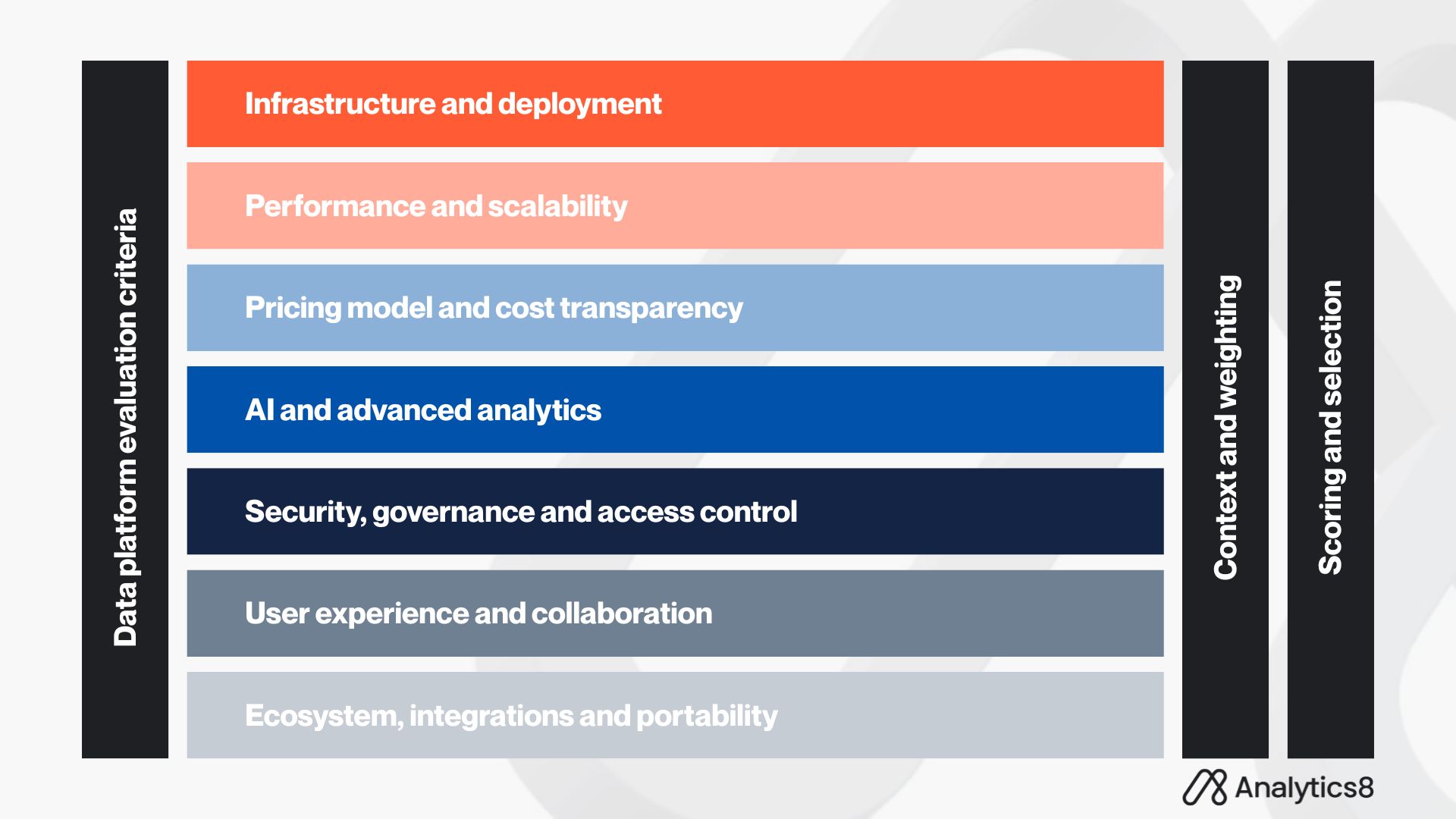
1. Infrastructure and deployment: How much control do you need over your infrastructure, and how much operational overhead are you prepared to carry? There’s a spectrum from platforms deployed in your own cloud account with full networking control, through to fully managed SaaS where everything is abstracted away. Compliance requirements, DevOps maturity, and IaC practices all influence where the right answer sits.
2. Performance and scalability: The question isn’t just whether a platform can scale, but whether it scales efficiently for your specific workload mix – high-concurrency SQL, large-scale ETL, streaming pipelines and ML workloads all make different demands. The tuning overhead required from your team is part of the answer.
3. Pricing model and cost transparency: The billing models are structurally different across the three platforms – consumption-based and capacity-based – and total cost of ownership can vary significantly depending on usage patterns. Beyond headline pricing, consider procurement complexity and cost attribution for specific workloads or teams.
4. AI and advanced analytics: This is where the platforms diverge most sharply. The question isn’t whether a platform supports AI – all three can. It’s whether it supports the full ML lifecycle for your specific use cases: training, experiment tracking, model registry, deployment and serving, including GenAI use cases.
5. Security, governance and access control: Governance is the foundation that makes analytics & AI safe to deploy at scale. How each platform handles fine-grained access control, data lineage, data quality monitoring and metadata management varies significantly – as do the trade-offs between control, ease of management and enterprise identity integration.
6. User experience and collaboration: The best platform is the one your team uses. That means thinking beyond the engineering interface to consider the experience for SQL analysts, data scientists and less technical business users. Learning curve and the quality of collaborative tooling all affect adoption.
7. Ecosystem, integrations and portability: How well does it integrate with your existing source systems, BI tools, orchestration layer and downstream consumers? And critically – if your strategy changes in three years, what does it cost you to move? Storage format, proprietary features and exit complexity should feed into the decision.
Law Society: When The Right Process Leads To The Right Platform
Law Society had existing Azure infrastructure, Power BI embedded across the organisation, and some internal SQL capability.
The immediate gut instinct may have pointed towards Microsoft Fabric because its a familiar, low-friction and a credible answer to their near-term reporting needs. But their ambitions ran well beyond near-term reporting: intelligent segmentation models, real-time behavioural analytics and GenAI use cases were all on the roadmap. The platform decision needed to serve all of it.
After running a comprehensive scoring criteria involving people across technical and business functions, three criteria clearly separated the platforms:
- AI Readiness: The biggest gap in the evaluation. Future use cases demanded genuine end-to-end ML lifecycle support. Databricks scored materially ahead on both model training and diverse LLM and GenAI use cases.
- Data Governance: Databricks fine-grained access controls, metadata, and lineage gave a level of auditability and discoverability that alternatives couldn’t match without additional tooling.
- Commercial framework: Procuring Databricks through their existing Microsoft Azure relationship meant a familiar billing model, unified support across their estate and significantly less procurement friction than introducing a new vendor.
The recommendation was Azure Databricks, not because it was the obvious first choice, but because it was the right one.
The Bottom Line
All three platforms are capable, all three are improving, and all three have weaknesses their advocates minimise. The job isn’t to pick the one your team is most comfortable with – it’s to pick the one that best underpins your business ambitions, evaluated honestly against criteria that reflect where you’re going.
If you are finding the decision daunting, we have the framework and expertise to take you through an impartial selection process. Get in touch! Book a free, no-pressure strategy session with one of our senior consultants. We’ll talk through where you are, what’s blocking progress, and what a practical path forward could look like.