
For most of the last decade, the ethical questions about AI have been questions about the outputs and how people use them. Is this credit score fair? Is this prediction accurate for everyone it affects? Can we explain why the model ranked one candidate above another? In each case there’s a person still sat between the model and the consequence, deciding whether to act. This is still critical and encourages a human-in-the-loop view of AI.
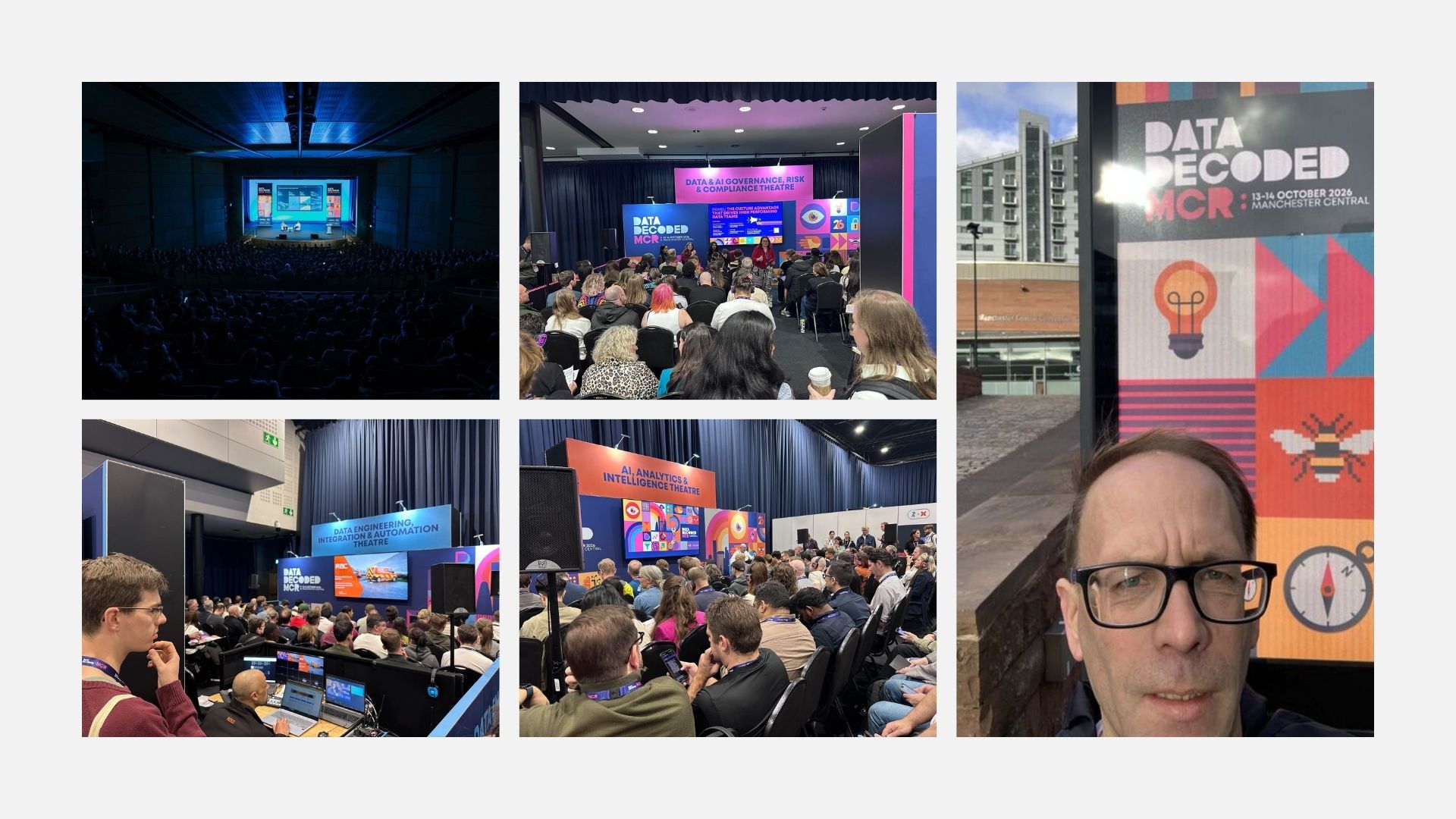
Two days well spent; plenty to think about.
Across both days, the sessions were informative and high quality. One message kept coming back: AI is only as good as the data, context and governance behind it. Here are the themes that stood out.
#1 Agentic AI is where the value is expected, but it isn’t always the answer
Agentic AI means systems built on large language models (LLMs) that can use tools, remember and act autonomously. It was widely seen as the most likely source of business value. But autonomy sits on a spectrum. A fully agentic architecture is costly and isn’t always right for the task. A solution can be agentic. It doesn’t have to be.
This was echoed on Day 2. Several speakers warned against assuming LLMs can do anything and throwing every problem at them. Getting it right means understanding the problem first and then choosing the best-suited approach or model, AI or not. That also means weighing the trade-offs of cost, latency and sovereignty.
Not every problem needs AI, and not every AI problem needs an agent. Knowing when to apply which approach is now a core skill.
#2 Traditional data science and ML are still mainstream
This was Paul’s favourite theme. Several speakers said the most common use of AI in their organisations was still traditional machine learning and statistical methods. These remain essential where determinism, explainability and cost matter most.
AI is more than LLMs and agents. The best results for complex and multi-task problems may well come from combining them. Being able to navigate the data science lifecycle, ask the right questions and translate results into insights for a specific problem are still key.
#3 Data has a new consumer: the agent
Data and the outputs built from it have usually been designed for people to use. Now we may also need to design for AI agents to use them.
That makes the data professional’s role more important than ever. Building the semantic layer, making sure data is high quality and capturing metadata are no longer nice to haves. Without them, the agent is flying blind.
Context matters most of all. The context given to an LLM needs to be designed and engineered on purpose. Unless you can explain to the agent the meaning of datasets, business rules it must follow, and how it must operate, the agent may not produce the outputs you want or quickly derail. But governing the context layer is hard, because most governance tools were built for people to act on, not agents.
#4 The fundamentals are back, and now they’re the key to AI
It was striking how many sessions returned to the fundamentals: data quality, governance and management, and the semantic layer. Data professionals have always known these matter. The difference now is that data foundations are what make Agentic AI possible.
On Day 2, a speaker in one session noted that data governance rarely sits high on the C-suite agenda. Their suggestion was to reframe data management as AI enablement. Without good governance, AI can’t work reliably or in ways people can trust. Framed this way, it could unlock the investment that data foundations have long requested.
#5 Governing agents means knowing who they are and what they did
Governance of AI agents came up on both days. One practical point from a talk by the ICO stood out: each AI agent needs a unique identity, and its interactions need to be recorded. That is what makes it possible to control access, apply kill switches and keep the audit trails regulators and businesses will expect.
You can’t rely on model providers to do this. Developers will need to build in governance through advanced telemetry and observability themselves.
Regulation adds to the pressure. A session led by data protection lawyers highlighted how hard it is to handle personal data carefully when using AI. Organisations need to be able to defend and evidence their decisions and actions when they receive subject access requests, which could include prompts and AI-generated outputs.
A Day 2 panel on ROI (Mirage or oasis) raised three more challenges: sovereignty, cost and shadow AI. Each interplay with trying to work out the ROI for AI and agentic workloads and each are high up on the agendas of organisations trying to adopt AI.
#6 AI is a transformation, not a bolt-on
Many sessions made the point that AI changes how a business works rather than adding to it. One analogy stuck. When electricity replaced steam, factories weren’t just rewired. They had to be redesigned and rebuilt. Organisations face the same challenge now. Getting real value from AI means redesigning workflows, not just tweaking the old ones.
That has a big impact on people. Some organisations are already treating agents as workers on the team. Staff need new skills, and not only technical ones, since AI can now do much of that faster than humans. The growing skills include:
- Asking the right questions
- Knowing what data an AI tool needs
- Selecting the right models and approaches
- Evaluating AI outputs
- Managing models and workflows
#7 Start small and build: incremental beats big bang
More than one speaker described doing platform modernisation and infrastructure change step by step rather than all at once. Many organisations have already invested in data platforms that can now support data science and AI applications.
The advice was practical: start with use cases that deliver business value using the people and technology you already have, then build from there.
What this means for data teams
The clearest message from Data Decoded 2026 is that AI is not making data engineers and data platform teams obsolete. They are needed more than ever.
The data team keeps AI safe and lets it work well. It improves AI outputs through better metadata descriptions, metric views, semantic layers, data governance and data quality. It is also what builds trust in Agentic AI.
What is changing is the focus. Data teams are moving from preparing data for people to use towards maintaining the context that agents depend on.
How Analytics8 can help
Much of what we heard at Data Decoded reflects what we already see with clients. The organisations getting real value from AI are the ones that get their foundations right, choose the right approach for each problem and redesign how they work, step by step.
At Analytics8, we work alongside clients from strategy through execution and enablement. We help them build the data foundations, semantic layers and governance that make AI work. We also help them decide where Agentic AI adds value and where a simpler approach will do the job better.
Want to know whether your data is ready for Agentic AI?
Book a 30-minute strategy session with our senior team. We’ll talk through where you are, what’s blocking progress, and what a practical path forward could look like.